
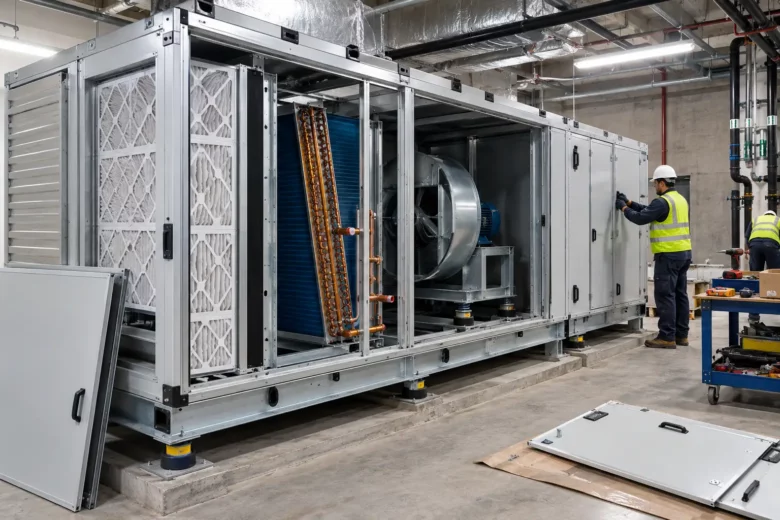
Replacing a large air handling unit is not always as simple as selecting equipment and moving it into the mechanical room. Existing facilities may have narrow corridors, limited door openings, rooftop constraints, occupied areas, structural restrictions, or equipment rooms built around the original unit.
Field-built and knockdown air handling units provide alternatives when a conventional factory-assembled unit cannot be delivered or installed intact. Both approaches allow large or highly customized equipment to reach challenging locations, but they differ in how the unit is manufactured, shipped, assembled, and coordinated in the field.
What Is a Field-Built Air Handling Unit?
A field-built AHU is assembled at the facility from structural, casing, and mechanical components. The design can be developed around the available equipment-room footprint, existing ductwork, structural conditions, access path, and required performance.
This approach is useful for very large systems and locations where even major prefabricated sections cannot pass through the available openings. It can also support unusual configurations involving filtration stages, coils, dampers, humidification, mixing sections, fan arrays, or other facility-specific components.
What Is a Knockdown Air Handling Unit?
A knockdown AHU is engineered so it can be shipped in smaller sections or components and assembled at the project site. More of the fabrication and fit-up planning may occur before shipment, while final assembly takes place after the pieces have been moved through the available access path.
Knockdown construction can be a practical solution when a complete unit is too large to deliver but the site can accommodate planned modules or panels. The allowable section size depends on doors, elevators, roof hatches, corridors, cranes, structural openings, and the layout of the mechanical room.
The Main Difference Is the Project Delivery Strategy
Both solutions address access and customization, but the balance between factory preparation and field construction is different. A knockdown unit generally arrives as an engineered package intended for site assembly. A field-built unit may require more extensive fabrication and integration within the final equipment location.
The right approach depends on the degree of customization, maximum component size, labor conditions, schedule, available staging space, facility operations, and the complexity of connecting to existing systems.
When Restricted Access Drives the Decision
Before selecting either approach, the project team should survey the complete delivery path. That includes loading areas, elevators, stairs, doors, hallways, roof openings, structural clearances, turning radiuses, and space for staging and assembly.
The survey should also account for components that cannot be reduced below a certain size. Coils, filters, dampers, fans, and access doors may establish practical limits even when the casing can be delivered as smaller panels.
Performance Still Comes First
Access is only one design constraint. The AHU must deliver the required airflow, external static pressure, temperature and humidity control, filtration, redundancy, sound performance, casing integrity, and energy performance for the application.
Facilities such as laboratories, data centers, food-processing plants, cleanrooms, federal buildings, and military installations may have demanding requirements. The design may need to address thermal bridging, casing leakage, washdown or cleanability, corrosion resistance, high-efficiency filtration, fan redundancy, controls integration, and future service access.
Questions That Help Define the Best Approach
The project team should identify the required airflow and psychrometric performance, available footprint, largest permissible shipping section, shutdown window, staging area, structural loading, existing duct and piping connections, filtration requirements, redundancy needs, controls interface, and testing expectations.
It is also important to decide whether the existing air handler will remain operational during part of the work. A phased plan may influence how the new unit is divided, assembled, connected, and commissioned.
Choose the Solution Around the Facility
There is no universal advantage to field-built or knockdown construction. The better solution is the one that satisfies the operating requirements while accounting for the real access, schedule, and installation conditions at the facility.
ACT designs and manufactures custom air handling solutions for projects where standard equipment does not adequately address the application. A review of the drawings, site conditions, performance specifications, and delivery path helps establish the most practical project strategy.
Need a Custom AHU for a Difficult Installation?
Contact Air Cleaning Technologies to discuss the facility, application, access limitations, performance requirements, and project schedule. Our team can help evaluate whether a field-built, knockdown, restoration, or other custom AHU approach fits the project.