
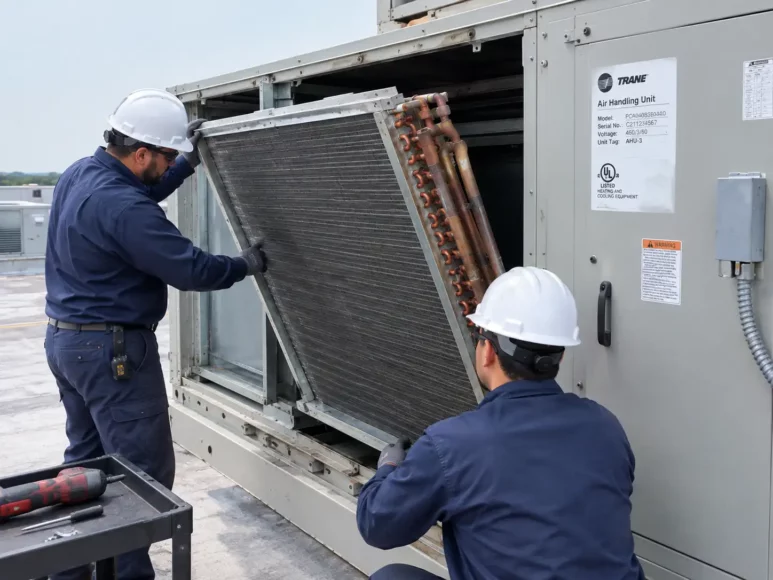
A leaking or underperforming coil does not automatically mean that the entire air handling unit must be replaced. In many commercial and industrial systems, a replacement coil can be designed and manufactured to fit the existing unit while restoring the heating or cooling function the system requires.
The decision is not based on age alone. The condition of the air handler, the accessibility of the coil, the accuracy of the available design information, and the facility’s future operating requirements all matter. Before choosing a coil-only replacement, the project team should determine whether the existing unit is structurally and mechanically worth preserving.
When a Coil-Only Replacement May Make Sense
A coil-only replacement is often practical when the air handler casing, structure, fan section, filtration section, dampers, and other major components remain serviceable. It may also make sense when the unit is custom-sized, built into the facility, or difficult to replace without major demolition and interruption.
Facilities may consider this approach when an otherwise functional unit has a leaking chilled-water coil, a failed steam coil, severe fin damage, corrosion, freeze damage, or insufficient performance that can be corrected through a properly selected replacement.
The New Coil Must Fit and Perform
Matching the outside dimensions is only one part of the project. The new coil must align with the existing airflow, piping, drainage, casing, access, and support conditions. It must also provide the required capacity without creating an unacceptable pressure drop or operating problem elsewhere in the system.
A direct physical copy may not be appropriate if the building load, process, outdoor-air requirement, fluid temperature, or airflow has changed. Current design conditions should be reviewed so the replacement is selected for the system the facility operates today.
Access Can Determine the Installation Strategy
Mechanical rooms, penthouses, interior equipment rooms, and older facilities may not provide a clear path for a large assembled coil. The project team should measure doors, corridors, hatches, wall openings, and the air handler access section before production begins.
Depending on the conditions, the work may require partial disassembly, a segmented approach, temporary removal of casing panels, or coordinated rigging. These installation realities should be considered during design, not after the replacement arrives on site.
When the Air Handler Needs More Than a Coil
A coil-only replacement may not be the best investment when the casing has significant air leakage, insulation has deteriorated, drain pans are failing, dampers no longer operate, filters do not meet current requirements, fan performance is inadequate, or multiple sections are approaching failure.
In those situations, an air handler restoration or custom replacement may provide a more complete solution. Restoration can address selected components and casing deficiencies while retaining usable portions of the system. A custom AHU may be appropriate when the unit can no longer support the facility’s airflow, filtration, temperature, humidity, redundancy, or process requirements.
Questions to Answer Before Making the Decision
The evaluation should establish why the coil failed, whether the existing unit is structurally sound, whether current operating conditions differ from the original design, how the coil will be removed and installed, what shutdown window is available, and whether other AHU components are likely to require near-term replacement.
The answers help compare the immediate cost of replacing the coil with the long-term value of restoring or replacing a larger portion of the system. The least disruptive option today is not always the least disruptive option over the next several years.
A Project-Specific Evaluation Is Essential
Commercial HVAC systems vary widely, especially in older, industrial, institutional, and purpose-built facilities. A sound recommendation requires drawings, field dimensions, equipment information, operating conditions, photographs, and an understanding of the facility’s goals.
ACT evaluates the coil as part of the complete air-handling system. That approach helps determine whether a custom replacement coil can solve the problem or whether the air handler needs a broader restoration or replacement plan.
Evaluating a Failed or Obsolete HVAC Coil?
Contact Air Cleaning Technologies with the unit information, coil measurements, photographs, drawings, and current operating requirements. We can help evaluate whether a replacement coil, AHU restoration, or custom air handler solution is the appropriate direction for the facility.