
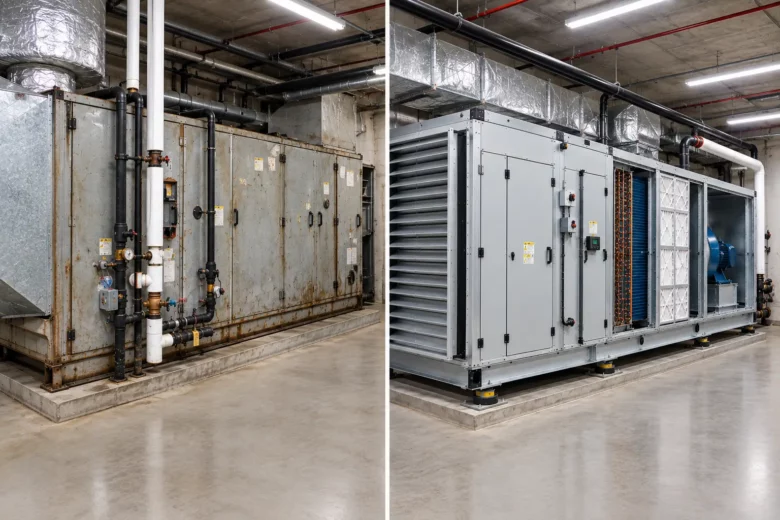
Many commercial and institutional facilities operate air handling units that were designed decades ago. The original manufacturer may no longer support the equipment, replacement parts may be difficult to obtain, and a standard modern unit may not fit the existing mechanical room or connection points.
Replacing obsolete equipment does not always require redesigning the entire facility. A custom air handling unit can often be developed around the existing footprint, ductwork, piping, structural conditions, access limitations, and current performance requirements. The key is to evaluate what can reasonably remain and what must change.
Begin With the Facility’s Current Requirements
The replacement should not be based only on the original equipment schedule. Building use, occupancy, outdoor-air requirements, filtration, process loads, controls, and operating schedules may have changed. The first step is to define what the air handler must accomplish now.
Document required airflow, static pressure, heating and cooling capacity, temperature and humidity control, filtration, redundancy, acoustics, casing performance, and any application-specific requirements. Current operating data and a review of recurring complaints can help identify deficiencies that should not be carried into the new equipment.
Survey the Existing Air Handler and Mechanical Room
A detailed field survey should record the unit dimensions, section arrangement, duct connections, piping, electrical service, controls, drains, structural support, service clearances, and equipment access path. Photographs, field sketches, scans, and existing drawings can be used together to document the conditions.
The survey should identify obstacles that affect both removal and installation. A large original unit may have been installed before walls, roofs, or surrounding equipment were completed. The new design may need to be delivered in smaller sections or assembled in place.
Determine What Can Be Reused
Existing ductwork, piping, electrical infrastructure, structural supports, and controls may be reusable when their condition and capacity are suitable. Reuse can reduce disruption, but it should be an engineering decision rather than an assumption.
Connections may require transitions or modifications when the new unit has a different internal arrangement. Piping that appears serviceable may still be undersized for updated performance. Structural framing should be evaluated when equipment weights or load distribution change.
Design the New AHU Around the Available Space
Custom equipment allows the casing dimensions, section order, access doors, connection locations, and component arrangement to respond to the mechanical room. This can be especially valuable when ceiling height, columns, walls, adjacent equipment, or service aisles restrict the available footprint.
The design should preserve adequate access for filters, coils, fans, dampers, drains, sensors, and future maintenance. Fitting the unit into the room is not enough if routine service becomes impractical after installation.
Use the Project to Correct Existing Weaknesses
An obsolete AHU replacement creates an opportunity to address problems such as casing leakage, thermal bridging, deteriorated insulation, poor drainage, inadequate filtration, inefficient fan systems, difficult maintenance access, or limited controls visibility.
The appropriate improvements depend on the application. A data center may prioritize redundancy and continuous operation. A food-processing facility may emphasize cleanability and corrosion resistance. A laboratory may require precise pressure, filtration, temperature, or humidity control.
Plan for Removal, Installation, and Downtime
The installation strategy should be developed alongside the equipment design. Define how the existing unit will be isolated and removed, how replacement sections will enter the building, where components will be staged, and how long the system can be unavailable.
Field-built or knockdown construction may be necessary when access is restricted. A phased project, temporary conditioning, off-hour work, or coordinated shutdown may be required when the air handler supports critical operations.
Testing and Commissioning Complete the Replacement
Once installed, the new AHU should be checked for proper assembly, casing integrity, airflow, component operation, controls response, drainage, filtration, temperatures, and other specified performance requirements. Testing should be planned before construction so the project team agrees on the measurements and acceptance criteria.
A successful replacement is not simply a newer box in the same room. It is an air-handling solution designed to work with the existing facility while meeting current operational needs.
Custom Replacement, Restoration, or a Hybrid Approach
Some projects require a complete custom AHU. Others can be addressed through restoration, component replacement, or a phased combination of new and retained sections. The decision should consider remaining equipment life, performance, installation risk, downtime, maintainability, and long-term capital planning.
ACT can assess existing air handling equipment and help develop a solution around the facility’s space, access, connections, and performance requirements.
Planning the Replacement of an Aging Air Handler?
Send Air Cleaning Technologies the available drawings, equipment information, photographs, operating data, specifications, and known facility constraints. Our team can help evaluate a custom replacement, AHU restoration, or phased solution for the existing system.