
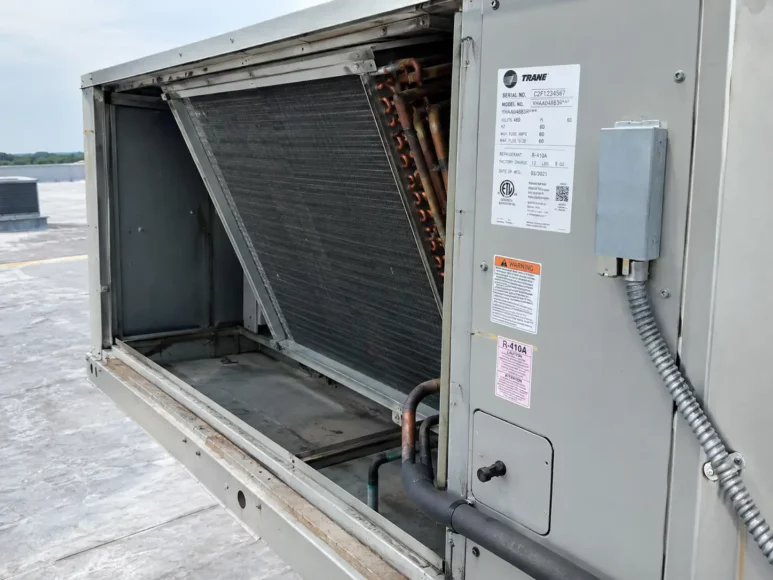
When a commercial HVAC coil begins leaking, loses capacity, or reaches the end of its service life, the first question is often simple: Can a replacement be manufactured to fit the existing equipment? The answer usually depends on the quality of the information available at the beginning of the project.
A coil may look straightforward from the outside, but its performance depends on more than its overall height, width, and depth. The coil type, tube and fin construction, number of rows, connection arrangement, airflow, fluid temperatures, pressure requirements, and available installation space all influence the replacement design. Providing complete information helps reduce unnecessary back-and-forth and allows the manufacturer to evaluate both fit and performance.
The following checklist explains what facility managers, engineers, mechanical contractors, and purchasing teams should gather when requesting a replacement HVAC coil quote.
Start With the Existing Equipment Information
Record the air handling unit manufacturer, model number, serial number, and equipment tag whenever they are available. A photograph of the nameplate can be more reliable than transcribing the information by hand. If the original submittal, schedule, drawing, or maintenance record is available, include it with the request.
Original documentation is helpful, but it should not be treated as proof that the installed coil still matches the original design. Equipment may have been modified during previous repairs or renovations. Field measurements and current operating requirements are therefore still important.
Identify the Coil Type and Application
State whether the coil is used for chilled water, hot water, steam, refrigerant, heat recovery, or another application. The intended service affects circuiting, materials, connections, casing construction, and design conditions.
Also describe where the coil operates. A coil installed in a standard commercial air handler may face different requirements from one serving a food-processing plant, laboratory, data center, manufacturing facility, or outdoor air system. Environmental conditions and process requirements can influence material selection and corrosion protection.
Provide Accurate Physical Dimensions
Measure the overall casing height, width, and depth, along with the finned height and finned length. Include the casing flange dimensions, mounting configuration, header locations, connection locations, and the space available to remove and install the coil.
Photos should show the full coil face, both connection ends, the casing, access panels, piping, and nearby obstructions. Place a tape measure in the photograph where it helps confirm scale. If access is restricted, note the largest opening through which the replacement must pass. A correctly sized coil still creates a project problem if it cannot be moved into the mechanical room or installed through the available access.
Document the Coil Construction
When possible, identify the tube diameter, tube material, fin material, fin spacing, number of rows, header material, casing material, and connection type. Note whether the existing coil has intermediate supports, drain provisions, protective coatings, or other special construction.
If some of these details cannot be confirmed in the field, say so. Photographs and available drawings may allow the manufacturer to identify what can be retained and what must be verified before production.
Include the Required Operating Conditions
A replacement should do more than occupy the same opening. It must also meet the system’s performance requirements. Provide the airflow, entering and leaving air temperatures, entering and leaving fluid temperatures, fluid type and concentration, flow rate, operating pressure, allowable air-side pressure drop, and any known capacity requirement.
For refrigerant coils, include the refrigerant, evaporating or condensing conditions, circuit requirements, and applicable equipment information. For steam coils, provide the steam pressure and describe freeze-protection concerns. If the project is intended to correct a performance problem, explain what the existing system is doing and what result is required.
Explain the Reason for Replacement
Tell the manufacturer whether the coil is leaking, corroded, damaged, repeatedly freezing, difficult to clean, underperforming, or simply obsolete. This context may reveal that duplicating the existing construction is not the best solution.
For example, premature corrosion may justify a different tube, fin, casing, or coating selection. A capacity complaint may require a performance review rather than a direct dimensional copy. Recurring freeze damage may point to airflow, controls, drainage, or operating issues that should be considered as part of the project.
What to Send With the Quote Request
A strong request package typically includes the equipment tag, manufacturer and model information, coil type, field dimensions, connection details, construction materials, design conditions, drawings, photographs, required schedule, delivery location, and the name of a technical contact who can answer follow-up questions.
Not every project begins with complete records. ACT can review the information that is available and identify the additional measurements or operating details needed to move the request forward. The goal is to develop a replacement that fits the application, connects properly, and delivers the required performance.
Need Help Identifying a Replacement Coil?
Send Air Cleaning Technologies the available equipment information, photographs, drawings, dimensions, and operating conditions. Our team can review the request, identify missing details, and help determine the appropriate next step for your commercial HVAC coil replacement project.